

A few lines of background.
The growing complexity of novel biotherapies and next-generation diagnostics is driving unprecedented analytical demands. Biosensing technologies continue to evolve, with new instruments, assay formats, and nanomaterials pushing performance further in automation, sensitivity, and throughput. But what about the biointerface and how biomolecules are immobilized on sensor surfaces?
Immobilization strategies: the SAMs
Three major strategies are commonly used to immobilize ligands on sensor surfaces: passive adsorption, affinity-based capture, and covalent coupling. Among the latter, covalent surface chemistries can broadly range from 2D self-assembled monolayers (SAMs) to thicker 3D polymer or hydrogel coatings. In simple terms, 2D surface chemistries use a thin, highly organized layer to prioritize control over surface interactions, while 3D surface chemistries use thicker coatings to increase loading capacity.
K-One: redefining surface chemistry.
K-One is Kimialys’ proprietary SAM technology, optimized for gold surfaces such as nanoparticles, chips, and electrodes. What sets it apart from conventional SAMs and other immobilization strategies is the level of control over surface interactions it delivers, shaped by more than ten years of research and optimization initiated at Paris-Saclay University and further developed by Kimialys. It enables simultaneous control over ligand exposure, density, distribution, and surface shielding against non-specific binding, thereby improving sensitivity, specificity, selectivity, and reproducibility without forcing the usual trade-offs between these key assay parameters. It has been at the core of Kimialys since the company’s creation in 2020 and remains the technological platform behind all our products and services today.
Kimialys: One for all, all for K-One.
On paper, it can sound almost magical, as if surface complexity could simply disappear with a touch of K-One and performance would naturally follow. As scientists, we know reality is more complex. Across such diverse applications, and with biomolecules that differ widely in structure, affinity, and behaviour, success still depends on fine-tuning multiple parameters. That is why we built a team of biophysicists and chemists under one banner. Kimialys is not just K-One as a technology; it is the scientific team that applies it, adapts it, and continuously refines it under real experimental conditions.
Surface chemistry matters more than ever.
To meet the stringent analytical requirements of modern drug discovery and diagnostic development, assays must deliver high-quality, reliable, and exploitable data. This is even more critical in the era of computational design, where increasingly high-affinity biomolecules with less conventional structures and behaviors are raising the bar for both characterization and detection. In this context, a partner with deep expertise in surface chemistry becomes essential for robust assay development, experimental validation, sequence refinement, and iterative model improvement.
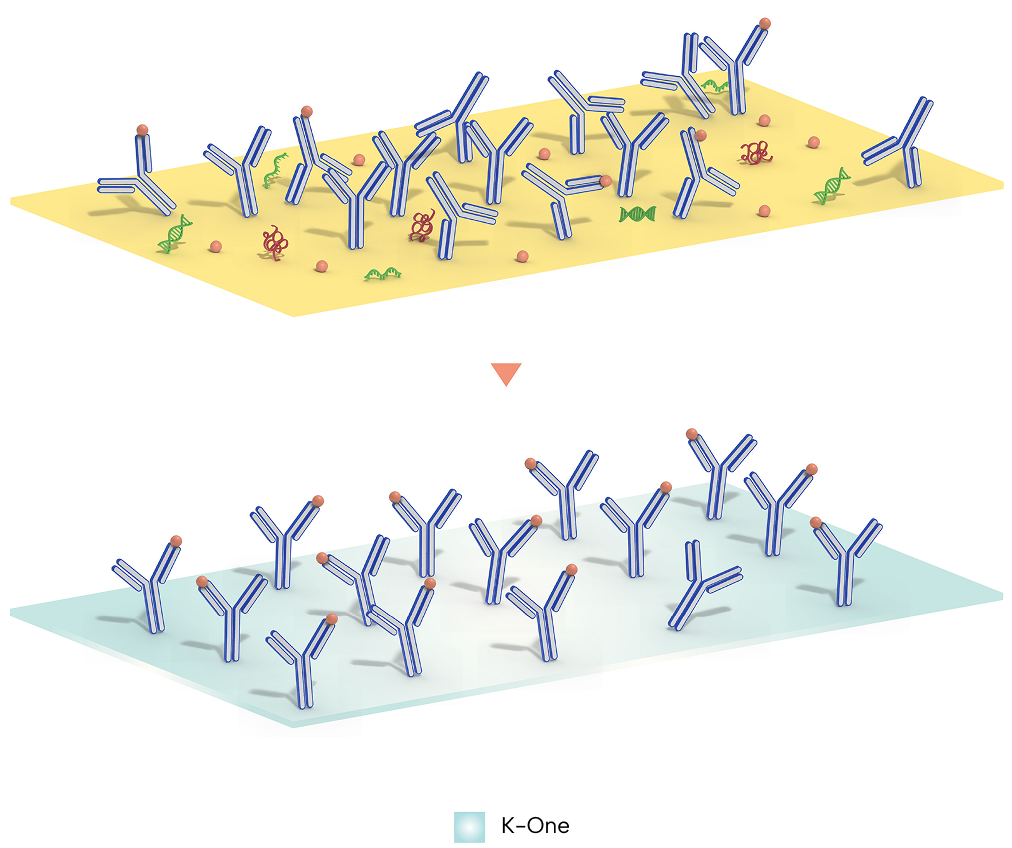
Figure 1 - Ligands bind to the surface of gold nanoparticles or chips in an uncontrolled or even random fashion, resulting in only 20-30% of the ligands being available to interact with their target, while excessive non-specific binding occurs on the surface.
Figure 2 - The K-One technology allows precise control over the ligands' exposure, density, and distribution, while providing a protective shield to the surface.
Exposure: ~90% of the ligands are available to interact with their target, including the most complex structures that are typically challenging to immobilize.
Shield: robust protection of the surface against non-specific binding, reducing background noise and enabling high-quality, reliable data.
Density/distribution: optimized ligand density and spatial distribution minimize avidity effects, mass transport limitations, and recapture, enabling measurements under true affinity-controlled conditions. This also reduces ligand requirements by up to 30x, significantly lowering assay costs.
Selected examples showing how K-One surface chemistry addresses critical biosensing challenges.
Biotech
Comprehensive SPR-based characterization of lead candidates targeting protein aggregates (e.g. Tau, Alpha-synuclein, Beta-amyloid aggregates), including Fc receptor study
Big pharma
Conclusive kinetic comparison between biosimilar drug candidates and a reference biologic, targeting interleukin
Big pharma
Development of a specific SPR chip to immobilize rabbit antibodies. The system demonstrated consistent antibody capture over multiple regeneration cycles
Diagnostic developer
Kinetic-based selection of hormone-targeting antibodies for point-of-care assay development
CDMO
Characterization of the interactions between fusion protein drug candidates and Fc receptors (FcRn, FcγRIa, FcγRIIa, FcγRIIIa)
Biotech
Screening of 40 non-purified antibodies to determine their interaction with different sequences (proteins and peptides)

Lorem ipsum dolor sit amet, consectetur adipiscing elit. Suspendisse varius enim in eros elementum tristique.

Pre-functionalization of SPR sensor chips using K-One® surface chemistry, specifically customized to your applications
Optimal ligand immobilization following Kimialys' proprietary protocol
In-house biomolecular interaction analysis with our own SPRi/SPR platforms
Reliable access to binding and kinetics data, complemented by high-quality reports and presentations, offering actionable insights
We harness both our expertise in SPRi and proprietary K-One® technology on chip to swiftly identify and rank both desired and undesired binding interactions among numerous candidates. This ensures our customers receive consistent and reliable results, accelerating their pursuit of new therapeutics.
We can immobilize any ligands:
Antibodies
Nanobodies
Small molecules
Proteins
DNA/RNA
Whole cells
Peptides
Aptamers
And more...
Our results are consistent and reliable for any complex biological matrices:
Plasma
Serum
Blood
Stem cell supernatant
Hybridoma supernatant
And more...
Reliable measurement of kinetic constants is pivotal for the development of new therapeutics. Leveraging our proprietary K-One® technology, we stand out in the SPR landscape by delivering precise characterization analysis for all biologics and compounds.
Kinetics measured:
Affinity (KD)
Binding rate constants (kon, koff)
Avidity
Pre-functionalization of SPR sensor chips using K-One® surface chemistry, specifically customized to your applications
Optimal ligand immobilization following Kimialys' proprietary protocol
In-house biomolecular interaction analysis with our own SPRi/SPR platforms
Reliable access to binding and kinetics data, complemented by high-quality reports and presentations, offering actionable insights
We harness both our expertise in SPRi and proprietary K-One® technology on chip to swiftly identify and rank both desired and undesired binding interactions among numerous candidates. This ensures our customers receive consistent and reliable results, accelerating their pursuit of new therapeutics.
We can immobilize any ligands:
Antibodies
Nanobodies
Small molecules
Proteins
DNA/RNA
Whole cells
Peptides
Aptamers
And more...
Our results are consistent and reliable for any complex biological matrices:
Plasma
Serum
Blood
Stem cell supernatant
Hybridoma supernatant
And more...
Reliable measurement of kinetic constants is pivotal for the development of new therapeutics. Leveraging our proprietary K-One® technology, we stand out in the SPR landscape by delivering precise characterization analysis for all biologics and compounds.
Kinetics measured:
Affinity (KD)
Binding rate constants (kon, koff)
Avidity
Pre-functionalization of SPR sensor chips using K-One® surface chemistry, specifically customized to your applications
Optimal ligand immobilization following Kimialys' proprietary protocol
In-house biomolecular interaction analysis with our own SPRi/SPR platforms
Reliable access to binding and kinetics data, complemented by high-quality reports and presentations, offering actionable insights
We harness both our expertise in SPRi and proprietary K-One® technology on chip to swiftly identify and rank both desired and undesired binding interactions among numerous candidates. This ensures our customers receive consistent and reliable results, accelerating their pursuit of new therapeutics.
We can immobilize any ligands:
Antibodies
Nanobodies
Small molecules
Proteins
DNA/RNA
Whole cells
Peptides
Aptamers
And more...
Our results are consistent and reliable for any complex biological matrices:
Plasma
Serum
Blood
Stem cell supernatant
Hybridoma supernatant
And more...
Reliable measurement of kinetic constants is pivotal for the development of new therapeutics. Leveraging our proprietary K-One® technology, we stand out in the SPR landscape by delivering precise characterization analysis for all biologics and compounds.
Kinetics measured:
Affinity (KD)
Binding rate constants (kon, koff)
Avidity
Pre-functionalization of sensor chips using K-One® surface chemistry, specifically customized to your applications and analytical platforms
Supply of batches of pre-functionalized sensor chips + ligand immobilization protocol and reagent
For companies looking to manage their own analyses, yet eager to leverage our expertise in chip functionalization and our proficiency in tackling complex analytical challenges.
We provide custom pre-functionalized sensor chips, specifically designed for your ligands, analytical platform, and applications, ensuring that your analyses run smoothly and effectively.
Gold-based sensor types:
For common SPR and SPRi platforms: Biacore, Horiba...
Other SPR-based biosensors: LSPR, Fiber Optic SPR, LR-SPR...
For chip-based diagnostic applications: electrochemical biosensors, QCM...
Our K-One® surface chemistry technology is available for licensing, offering the opportunity to integrate it within your own production environment and standards.
Lorem ipsum dolor sit amet, consectetur adipiscing elit. Suspendisse varius enim in eros elementum tristique.


Join our newsletter to stay up to date on features and releases.
By subscribing you agree to with our Privacy Policy and provide consent to receive updates from our company.
